Particle Pumpers: Is Your Vacuum Cleaner Harming Your Indoor Air Quality?
We measure what your vacuum leaves in the air and tell you how to fix it.
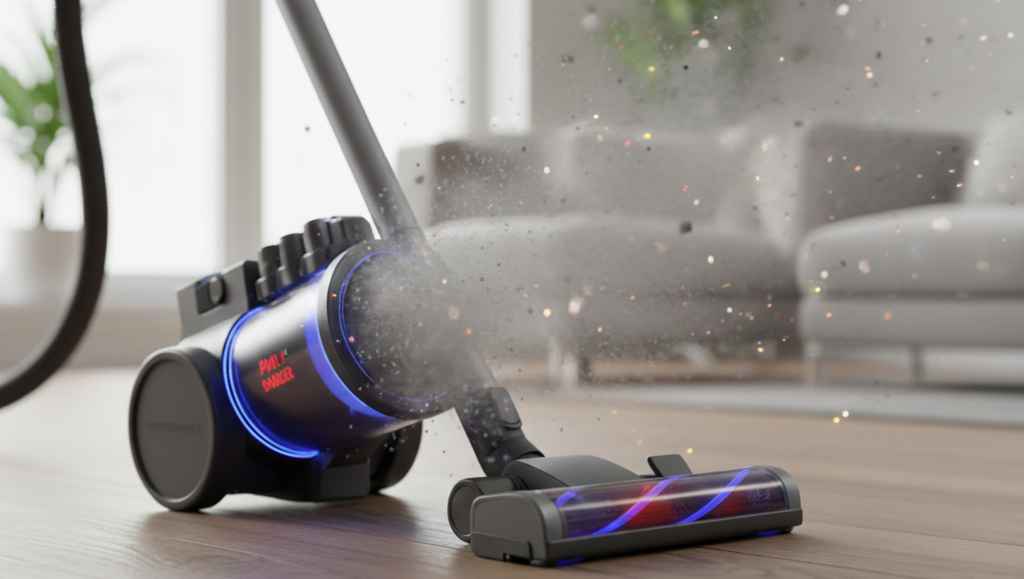
Vacuuming feels like a healthy habit. You push, the dust disappears, and the house looks fresh again.
But what if your vacuum is quietly releasing pollution back into the air you breathe?
Many everyday vacuums act like small pollution machines. Instead of trapping dust, they can leak microscopic particles, allergens, and even bacteria into your living space. Scientists call these models “particle pumpers” — machines that clean the floor but contaminate the air.
The Hidden Dust Cloud
When you switch on a vacuum, it moves a large volume of air in seconds. If the seals, filters, or housing leak, that airflow carries dust and tiny fragments right back into the room. The result is an invisible cloud you never see.
Tests on household vacuums have measured releases of up to 5,400 micrograms of fine dust per minute.
A microgram is one-millionth of a gram — about one grain of salt divided into twenty thousand parts. Even a small leak adds up quickly, filling the air with fine debris you can’t see but still inhale.
The Ultrafine Threat
The real concern isn’t the dust you notice, it’s the dust you can’t.
Fine particles, known as PM2.5, are small enough to reach deep into the lungs.
Ultrafine particles — those smaller than one-tenth of a micrometer — can go farther still. They can pass through lung tissue and move into the bloodstream.
Some of these particles don’t come from your carpet at all. They form inside the vacuum’s motor, where metal brushes and electrical parts grind against each other. Every minute of use can release billions of particles into the air.
For young children, older adults, and anyone with asthma or chronic lung disease, these exposures can worsen inflammation and make breathing more difficult.
When Clean Spreads Contamination
Vacuums don’t just release dust. They can also spread living matter.
Researchers have found bacteria and mold spores, including Aspergillus and Penicillium, coming out of vacuum exhausts. Some samples even contained genes linked to antibiotic resistance.
That means a vacuum can take what was on the floor and redistribute it through the air.
The room looks clean, but the air can be loaded with microbes too small to see.
The Limits of HEPA Filters
A true HEPA filter removes nearly all particles down to 0.3 micrometers, including most ultrafine particles. But a filter only works if the rest of the machine is airtight.
If the body, dust compartment, or seals leak, polluted air escapes before it passes through the filter.
Two vacuums with identical HEPA filters can have very different results.
Performance depends on design, tight seals, and regular maintenance.
Filters that are damp, torn, or loosely fitted lose their efficiency. Replacing them on time and sealing used filters before disposal keeps them working as intended.
Measuring What You Can’t See
Because fine and ultrafine particles are invisible, you can’t tell how your vacuum performs just by looking at it — or by its price tag.
Indoor Air Quality testing is the only reliable way to know.
Professionals use instruments that count airborne particles in real time.
Optical particle counters track fine dust. Condensation particle counters measure the smallest particles — the ones that can enter the bloodstream.
Testing identifies whether your vacuum traps what it collects or releases pollutants back into your home. The data can guide fixes, upgrades, or replacements that make a measurable difference.
A Clean Home Should Also Mean Clean Air
Vacuuming is supposed to remove contaminants, not move them around.
If your vacuum leaks or lacks proper filtration, your home may look clean but still contain polluted air.
A short indoor air assessment can confirm whether your “clean” is truly clean.
Protect your family’s health by verifying your defense against the invisible threat.
Schedule a professional indoor air quality test today and find out whether your vacuum is working for you — or against you.
References
Filterbuy. (2024). Is Indoor Air-Quality Testing Worth It? Retrieved October 14, 2025, from https://filterbuy.com/resources/how-to-guides-and-hvac-maintenance/indoor-air-quality-testing/
Knibbs, L. D., He, C., Veillette, M., Charlebois, R., Lajoie, P., Morawska, L., & Duchaine, C. (2012). Vacuum cleaner emissions as a source of indoor exposure to airborne particles and bacteria. Environmental Science & Technology, 46(1), 534–542.
Liu, Y., Zhao, J., Tao, J., Zhai, Z., Li, S., Wang, H., & Chen, G. (2015). PM2.5 damage on human respiratory system: A systematic review. International Journal of Environmental Research and Public Health, 12(11), 14317–14337.
National Academies of Sciences, Engineering, and Medicine. (2017). Indoor fine particle exposure and respiratory health: The role of residential sources. National Academies Press.
Particles Plus. (2024). Ambient Air Monitors. Retrieved October 14, 2025, from https://particlesplus.com/
Sarasota Vacuum. (2024). The HEPA Filter in Your Vacuum Cleaner. Retrieved October 14, 2025, from https://sarasotavacuum.com/the-hepa-filter-in-your-vacuum-cleaner/
U.S. Department of Labor, Occupational Safety and Health Administration (OSHA). (2015). Indoor air quality in commercial and institutional buildings (OSHA Publication 3430-05R).
U.S. Environmental Protection Agency. (2024). Improving Indoor Air Quality. Retrieved October 14, 2025, from https://www.epa.gov/indoor-air-quality-iaq/improving-indoor-air-quality
U.S. Environmental Protection Agency. (2024). Particulate Matter (PM) Basics. Retrieved October 14, 2025, from https://www.epa.gov/pm-pollution/particulate-matter-pm-basics
U.S. Environmental Protection Agency. (2024). What is a HEPA Filter? Retrieved October 14, 2025, from https://www.epa.gov/indoor-air-quality-iaq/what-hepa-filter
Veillette, M., Knibbs, L. D., Pelletier, A., Charlebois, R., Lecours, P. B., He, C., Morawska, L., & Duchaine, C. (2013). Microbial contents of vacuum cleaner bag dust and emitted bioaerosols and their implications for human exposure indoors. Applied and Environmental Microbiology, 79(20), 6331–6336.
Sources and related content